
Introduction:
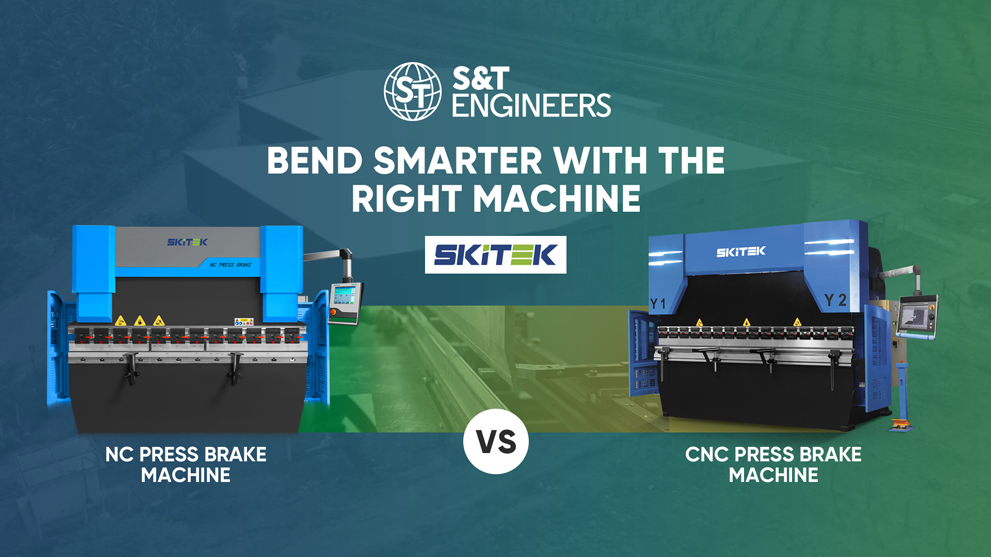
A press brake machine is an essential tool in modern metal fabrication, enabling precise sheet bending for components used across industries. Whether youre an OEM, MSME, or job shop, selecting the right press brake NC or CNC can significantly impact your production accuracy, setup time, and operational efficiency.
In this guide, we break down the types of press brake machines based on operation and automation, compare NC press brake vs. CNC press brake machines, and help you choose the right solution tailored to your material type, job volume, and bending complexity.
What is a Press Brake Machine?
A press brake machine is a metal forming tool used to bend sheet metal and plate materials into specific angles and shapes. Using a punch and die, the machine applies pressure to a workpiece, forming precise bends along a straight axis. It is essential in manufacturing parts for automotive, aerospace, furniture, appliances, and general fabrication.
Types of Press Brake Machines Based on Operation / Mechanism
1. Mechanical Press Brake
• Operates using a flywheel and clutch system.
• High-speed performance, ideal for high-volume, repetitive bending.
• Limited stroke adjustability.
2. Hydraulic Press Brake
• Uses hydraulic cylinders for controlled force.
• Offers greater precision, flexibility, and safety.
• Suitable for heavy-duty applications and thicker sheets.
3. Pneumatic Press Brake
• Operates with compressed air pressure.
• Best for light-duty tasks and thin materials.
• Faster but less powerful.
4. Servo-Electric Press Brake
• Powered by servo motors and ball screws.
• Highly accurate, eco-friendly, and low maintenance.
• Ideal for clean environments and light sheet bending.
Types of Press Brake Machines Based on Technology & Automation
1. NC Press Brake (Numerical Control)
✓ Basic control panel with limited programming.
✓ Suitable for simple bending jobs with consistent parameters.
✓ Requires manual input and adjustments for each job.
2. CNC Press Brake (Computer Numerical Control)
✓ Advanced multi-axis programmable control.
✓ Capable of complex bends, angle control, and part memory.
✓ Allows integration with CAD/CAM, robotic arms, and real-time diagnostics.
✓ Increase precision, speed, and productivity.
Why Choose an NC Press Brake Machine?
- Lower initial investment cost
- Great for basic operations with consistent job profiles
- Ideal for MSMEs or job shops with a limited budget
- Simpler to operate and maintain
Why Choose a CNC Press Brake Machine?
- Needed for high-precision and multi-bend complex parts
- Reduces material waste through programmed consistency
- Supports automation, fast changeovers, and productivity gains
- Best for OEMs, large fabricators, or batch-production units
Which One is Suitable for Your Needs?
|
Your Requirement |
Best Option |
|
Simple parts in bulk |
NC Press Brake |
|
Frequent job changes |
CNC Press Brake |
|
Tight tolerances, complex bends |
CNC Press Brake |
|
Budget-conscious operations |
NC Press Brake |
|
Automation-ready factory |
CNC Press Brake |
How to Select the Correct Press Brake Machine Based on Your Fabrication Needs
When choosing a press brake machine, consider the following:
✅ Type of Material
Mild steel, stainless steel, aluminum?
Thicker materials need hydraulic or CNC presses.
✅ Thickness & Length of Workpiece
Ensure the press has enough tonnage and bed length.
✅ Production Volume
High volumes = faster setup & cycle time (CNC recommended)
✅ Part Complexity
Multi-axis and programmable bends? Go with CNC.
✅ Operator Skill & Labor Availability
Less skilled labor? CNC machines reduce human error.
✅ Budget
Lower budget? NC press brakes are ideal for entry-level applications.
Conclusion
Choosing between NC and CNC press brake machines depends on your production complexity, budget, and long-term growth goals. While NC press brakes are great for straightforward tasks, CNC machines are built for precision, flexibility, and automation-ready workflows.
📞 Still Confused? Talk to Our Experts.
Get tailored recommendations based on your fabrication shop size, material types, and future expansion goals.
FAQ
❓ Is a press brake hydraulic or pneumatic?
A press brake can be hydraulic, pneumatic, mechanical, or servo-electric, depending on its design. However, hydraulic press brakes are the most commonly used in modern fabrication due to their superior force control, safety, and suitability for bending thicker materials. Pneumatic press brakes are typically used for light-duty applications and thinner sheet metals.
❓ What type of tooling is used in press brakes?
Press brakes use punch and die tooling to form sheet metal. Common types include
✓ V-dies for standard bending
✓ Gooseneck punches for clearance during complex bends
✓ Acute angle dies, hemming tools, and radius dies for special applications
Tooling is selected based on material thickness, bend angle, and part geometry.
❓ What are the applications of press brakes?
Press brakes are widely used in metal fabrication for bending sheet metal into precise shapes. Common applications include
✓ Automotive parts
✓ Electrical enclosures
✓ Cabinets and panels
✓ Furniture components
✓ Appliance housings
✓ HVAC ducting
They’re essential in industries like automotive, aerospace, construction, and general manufacturing.